


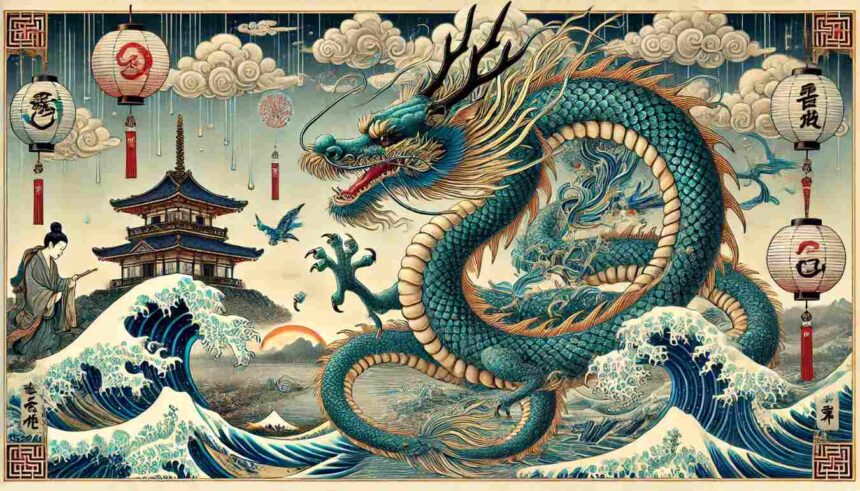
Japanese dragons, known as ryū or tatsu in Japanese, are fascinating mythical creatures deeply embedded in the country’s rich cultural history.
Origins of Japanese Dragons
The concept of dragons in Japan is closely tied to the country’s spiritual and religious history. Japanese dragons have a unique place in mythology that distinguishes them from other cultures’ depictions of dragons. Unlike Western dragons, which are often portrayed as evil or destructive, Japanese dragons are more often viewed as benevolent and protective figures.
The origin of Japanese dragons can be traced back to Chinese mythology, where the dragon is considered a symbol of imperial power, prosperity, and good fortune.
Over time, these dragons made their way into Japanese culture through Buddhist teachings, Chinese folklore, and early contact between China and Japan.
As the myths evolved, the Japanese began to adapt and create their own interpretation of these dragons, blending them with indigenous Japanese beliefs.
Physical Appearance of Japanese Dragons
Japanese dragons are often depicted as long, serpentine creatures with a combination of animal-like features. Their bodies are generally slim and sinuous, resembling a snake or eel, but with limbs like a lion or tiger.
A typical Japanese dragon will have a long, flowing body covered in scales, sharp claws, and a distinct head that resembles that of a camel or horse, complete with long, flowing whiskers.
They are often depicted with a fierce yet wise expression, showcasing their power and intelligence.
The dragon’s eyes are typically shown as piercing and commanding, adding to their mystical aura. Their ability to transform into various forms, from water to fire, is also a feature that sets them apart from other mythological creatures.
The Role of Japanese Dragons in Mythology
In Japanese mythology, dragons are not seen as mere creatures of destruction but are often associated with water and rain. They are believed to be the rulers of rivers, lakes, and seas.
Many Japanese dragons are considered to be water deities, and they have the power to control the elements of nature, especially rain and storms. These water dragons are often believed to bring life-giving rain to crops, ensuring a good harvest.
One of the most famous dragon myths in Japanese folklore is that of Ryujin, the dragon god of the sea. Ryujin is a powerful deity who rules over the oceans and is said to have the ability to control the tides.
According to legend, Ryujin lived in a magnificent underwater palace called the Ryugu-jo. He is also known for his ability to transform into a human form, often depicted as a wise and powerful being who helps those in need.
Another well-known dragon in Japanese mythology is the Yamata no Orochi, an eight-headed serpent-like dragon. This dragon is most famous for its battle with the hero Susanoo, who ultimately defeated the creature and freed the land from its terror.
Yamata no Orochi is one of the most iconic dragons in Japanese mythology, symbolizing chaos and destruction, but also the heroism that can arise from battling evil forces.
Symbolism of Japanese Dragons
Japanese dragons are rich in symbolism, representing a range of ideas that go beyond simple folklore. Here are some of the key symbols associated with Japanese dragons:
Strength and Power: Japanese dragons are often seen as symbols of strength and power, embodying the ability to control nature and the forces of the universe. Their power is often depicted as being both physical and spiritual, giving them a unique position in Japanese culture.
Wisdom and Knowledge: In addition to their strength, Japanese dragons are also symbols of wisdom and knowledge. The ability of these creatures to control the elements, especially water, makes them representations of the deep, mysterious forces of nature. Dragons are often thought to possess ancient knowledge and are seen as protectors of secrets.
Rain and Fertility: As water deities, Japanese dragons are closely linked to rain and the fertility of the land. In ancient Japan, the dragon’s ability to bring rain was a symbol of prosperity and abundance. Farmers often prayed to these dragons for good harvests, making them an essential part of agricultural life.
Protection and Guidance: Dragons in Japanese mythology are often seen as protective figures, watching over people and offering guidance in times of need. This is evident in stories where dragons help heroes or offer their protection to those who show respect and reverence. For example, Ryujin, the sea dragon, is often seen as a figure of protection for sailors and fishermen.
Transformation and Renewal: The dragon is also associated with transformation and renewal. In many myths, dragons undergo transformations, whether changing form or evolving into more powerful beings. This symbolizes personal growth, spiritual awakening, and the cycle of life, death, and rebirth.
Balance of Opposites: The dragon represents the balance between opposing forces, such as the yin and yang. In many ways, they embody the harmony between different elements, like fire and water or life and death. This balance is essential in maintaining cosmic order, a concept that is central to many Japanese philosophies and beliefs.
Japanese Dragons in Art and Culture
Dragons have been a popular subject in Japanese art for centuries. Traditional Japanese paintings, sculptures, and woodblock prints often feature these majestic creatures, showcasing their beauty and power.
The dragon’s depiction in art is typically intertwined with other symbolic elements, such as clouds, waves, and fire, creating a dynamic and lively representation.
One of the most famous examples of Japanese dragon art can be found in the Kinkaku-ji (Golden Pavilion) in Kyoto, where a dragon painting is displayed on the ceiling of the main hall. This artwork is said to represent the power and spiritual presence of the dragon as a guardian spirit.
Dragons are also commonly featured in tattoos, which have been popular in Japanese culture for centuries. Japanese dragon tattoos are not only a form of artistic expression but also carry deep symbolic meanings for the wearer.
The placement of the tattoo and the design often reflect the personal significance of the dragon, whether it represents strength, protection, or transformation.
Japanese Dragons in Modern Pop Culture
In modern Japan, dragons continue to hold a prominent place in popular culture. They appear in a variety of media, from anime and manga to video games and movies.
One of the most iconic modern representations of a Japanese dragon is Shenron, the dragon from the Dragon Ball series.
Shenron is a magical dragon who can grant wishes to those who summon him, showcasing the dragon’s ongoing importance as a symbol of power and transformation.
Dragons also appear in many other forms of Japanese entertainment, such as in films like Spirited Away, where they are depicted as mystical beings with great power.
In these modern portrayals, Japanese dragons are often shown as protectors, guides, or agents of change, continuing their symbolic role as important figures in Japanese culture.